Customer cases
How Visma Enterprise AS accelerated AI adoption with Unless
Version 1.0 · Published 2026-04-14
Introduction
Visma Enterprise AS is Norway’s leading provider of ERP and resource management solutions for the public and private sectors. With a customer base of 300+ organizations and 600,000–700,000 end users, and thousands of highly specific support tickets each month, customer support is both mission-critical and inherently complex.
The team was initially looking to replace an existing onboarding tool used for in-app guides and walkthroughs. However, the search quickly expanded into something bigger: how to modernize self-service and prepare for an AI-driven future. As the scope expanded, the team faced a familiar decision: build a solution in-house or move forward with an existing platform.
Rather than getting stuck in a typical “build vs. buy” discussion, the team chose speed. By implementing Unless, they were able to launch AI-powered search and chat in weeks, shifting their focus from infrastructure to user behavior, content quality, and measurable adoption. We spoke to Krišjānis Rērihs, Head of Digital Experience at Visma Enterprise AS, to find out more about their journey.
Identifying the strategy: Buy (not build)
The team at Visma Enterprise AS had a tight deadline to make the switch from their existing self-service solution and had to start looking for an alternative platform quickly. First, they approached the Visma group customer experience team to see what other Visma companies were doing, what solutions were available, already tested, and ready for implementation, so that they could get started as soon as possible. It wasn’t long before they kept hearing about Unless.
During that analysis phase, when comparing different solutions, we understood that by implementing Unless, we could not only swap the self-service tools but also get a more modern approach when it comes to AI solutions.
This led to a shift in their focus from not just replacing a tool but thinking of those features as legacy. They could still be provided, but the main journey would be AI-driven chat and search.
A major benefit here was also that we could use as few resources as possible to actually start an investigation of our own. The due diligence had already been done by experts in the Visma Group. All the agreements and requirements (ie, GDPR) were in place. That was our chance to leapfrog the building process and gain valuable time.
To make the transition as seamless as possible, Visma Enterprise AS created several user stories with things they’d need to have for their end users as well as for team members (including content admins, data analysts, product owners, and support agents). The user stories mapped out the context, needs and requirements along with real-life scenarios.
The collaboration with Unless was an important factor. It’s not something you can put on paper easily, but it’s something you feel along the way. They did a really good job not only in delivering our custom needs but prioritizing them in order to match our roadmap and strict deadline. We recognize that those requirements probably wouldn’t have been their top priority otherwise.
Implementation: AI search first
Most Unless customers start by introducing their support team to the Unless team assistant or the AI chat aimed directly at end-users. Visma Enterprise AS, however, took a less traditional approach and started with AI search instead. There were several reasons for this.
First off, search was their main priority since it’s something they were already offering their customers. They also acknowledged that not every user needed access to AI chat since their focus is on core users.
With 600–700k users, a full rollout would have flooded them with volume and even a simple “hi” from this many users would have added up. So they opted for a cautious, targeted approach rather than opening the gates all at once.
Starting with search meant keeping things operational with uninterrupted service for customers while the Visma Enterprise AS team worked on getting their documentation ready for AI.
Unifying all business knowledge
As with all AI implementations, it became clear early on that the AI is only as good as the content behind it. In the case of Visma Enterprise AS, they already had most of the necessary documentation, but it was scattered and inconsistent. The challenge was not a lack of information, but rather the inability to quickly surface the right answer in a highly complex and regulated environment.
To ensure high-quality outputs, they utilized Unless’s quality scores as a strategic roadmap to identify where content needed refinement. This effort was further guided by Visma Group’s data structuring guidelines, ensuring a consistent approach across the organization. To put this into practice, they launched the ‘RAG readiness’ summer project, where interns and AI-passionate consultants collaborated to sort, quality-assure, and rewrite hundreds of articles, specifically optimizing them for AI retrieval.
Because they wanted the Digital Handbook to remain as the definitive source of truth, all improvements were made directly at the source. Looking ahead, Visma Enterprise AS is focused on making the feedback loop even more efficient by allowing team members to rate, flag, and comment on answers in real-time. A key factor in this will be the further involvement of their consultants and support enthusiasts who, through the Team Assistant in Service Cloud, will work even closer with the AI to drive continuous content excellence.
We now have our own platform where we can gather all the documentation. This was equally important to get things up and running and has ensured the success of our AI implementation. Without it, we really would have struggled. It gave us a solid base for many other plans we have to improve the customer experience.
This Digital Handbook now serves multiple purposes, allowing them to continuously benefit from the work that was put in.
- Training the AI with all the business knowledge needed for search and chat.
- It’s become a perfect resource for customers. Once in the Digital Handbook, a customer can easily find everything they need, ensuring a unified experience.
- It’s used by the support team, creating a powerful feedback loop. If they see that the AI generates an answer that is unclear or incorrect, they can proactively flag it in Unless and update the documentation.
Advantages beyond deflection
The impact was both immediate and measurable. Since launching in June, Visma Enterprise AS has seen a drastic improvement in answer quality, with a clear upward trend over time. At its peak, the AI has fielded up to 22k responses and 44k searches per month, with high engagement overall. As AI handled more interactions, peak support load became significantly more manageable.
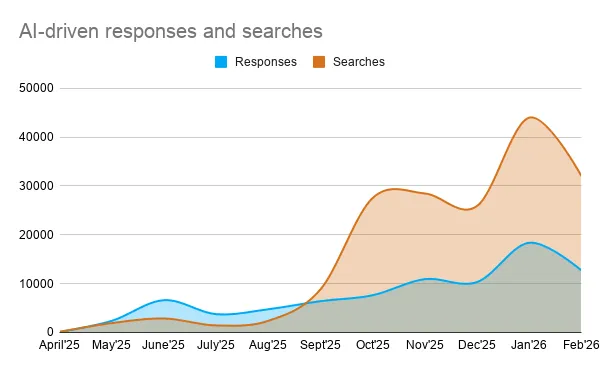
Just as importantly, the organization gained visibility into where answers fall short. AI effectively became a mirror, exposing gaps in documentation and alignment across teams. Instead of guessing what customers need, the team now uses real interaction data to guide improvements.
We see the result of actually putting the work and structure in place to get better answers. We learned a lot about what needs to be in place and now have the recipe for what needs to be done in terms of structure, processes, quality assurance, etc.
Overall, this journey has not only been about replacing a previous solution but so much more for the whole company. We’ve demonstrated what is possible, and it has opened a new chapter for the whole product strategy. We’ve learned a lot and plan to do much more!
Covering the entire user journey
Looking ahead to 2026, Visma Enterprise AS is shifting focus from rollout to continuous improvement and AI maturity. With a strong foundation in place, the next phase is about refining answer quality, increasing user confidence, and using interaction data to further optimize the customer experience.
Our focus now is on continuously improving the quality. Every interaction helps us identify where we can improve, and we can act on that quickly. We see a lot of potential in what’s coming next, especially with agentic AI skills. We’re convinced that our AI agents will be able to perform actions on behalf of a user before the end of this year.
Together with Unless, we’re also looking at how we can further grow our AI maturity across the full customer journey. As we grow as a company, our support abilities need to scale with us. The alternative is simply not sustainable.
Curious how your organization can take a similar approach? Get in touch and let’s explore how you can scale support while improving customer experience.
Key takeaways
- Choose speed over complexity. Buying a proven solution allowed Visma Enterprise AS to move quickly without getting slowed down by infrastructure, compliance, or internal development. This enabled the team to focus on delivering value rather than building and maintaining systems.
- Define a strategy that fits your organization. Successful AI implementation depends on context. Visma Enterprise AS tailored its approach to its user base and support model, starting with search and gradually expanding to AI chat, where it added the most value.
- Treat content as a continuous improvement process. High-quality content is essential, but it doesn’t need to be perfect from day one. By using AI to surface gaps and guide improvements, Visma Enterprise AS was able to iteratively strengthen its knowledge base and improve answer quality over time.